


 PLATFORM UPDATE:

Enhanced removal of fluoride and phosphate by nickel-doped kaolinite nano-adsorbents: mechanisms and resource recovery
 *a
Tahany
Mahmoud,
*b
*a
Tahany
Mahmoud,
*b
Abstract
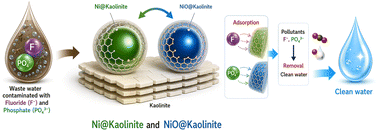
The development of efficient and cost-effective catalysts for wastewater treatment is crucial for mitigating environmental pollution. In this study, NiO and Ni-metal doped kaolinite-based nanocomposites were synthesized via precipitation and calcination methods and evaluated for fluoride (F−) and phosphate (PO43−) remediation. Comprehensive characterization was performed using X-ray diffraction (XRD), Fourier transform infrared spectroscopy (FT-IR), scanning electron microscopy-energy dispersive X-ray spectroscopy (SEM-EDX), Raman spectroscopy, Brunauer–Emmett–Teller (BET), and dynamic light scattering (DLS) analyses. The adsorption performance was systematically examined under varying pH, initial pollutant concentration, contact time, temperature, and adsorbent dosage. The Ni(OH)2@kaolinite composite exhibited the highest adsorption capacities: 52.6 mg g−1 for fluoride and 55.0 mg g−1 for phosphate, with over 90% removal efficiency under optimal conditions. Kinetic data were best described by the pseudo second order model, indicating that the adsorption rate depends on the availability of active sites and adsorption capacity; however, kinetic fitting alone was not used to assign the adsorption mechanism, which was further evaluated using diffusion and thermodynamic analyses. The composites demonstrated excellent reusability, retaining over 75% efficiency after 10 cycles. Compared to conventional adsorbents, the Ni-doped kaolinite showed superior performance and cost-effectiveness (estimated treatment cost: <$5 per 1000 L), highlighting its potential as a sustainable, scalable solution for industrial wastewater treatment and resource recovery.
 Please wait while we load your content...


