


 PLATFORM UPDATE:

Comprehensive study of tunable BiOI/BiOBr heterojunctions: reactive species and mechanistic insights for visible-light degradation of indigo carmine

Abstract
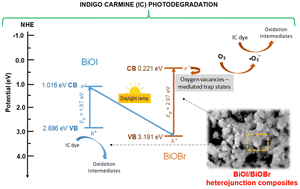
In recent years, heterojunction composites of bismuth-based oxyhalides (BiOX, X = F/Cl/Br/I) have emerged as effective visible-light-driven photocatalysts. Despite notable advances, particularly the promising performances of bulk BiOI/BiOBr in degrading methyl orange and the synergistic effects observed in their thin films for indigo carmine (IC) photodegradation, key gaps still persist. These include the lack of a comprehensive investigation into simple, tunable bulk BiOI/BiOBr heterojunctions and the insufficient elucidation of reactive species for charge-transfer mechanisms governing dye remediation. This study introduces a facile and scalable approach for synthesizing bulk BiOI/BiOBr heterostructures via a modified deposition–precipitation method, offering an efficient alternative to complex thin-film systems and providing the first comprehensive characterization, mechanistic insight, and reactive species identification into IC degradation over bulk BiOI/BiOBr composites. Evaluation of their photocatalytic activity towards IC degradation under 4-hour visible light irradiation demonstrated 0.6BiOI/0.4BiOBr with the best performance of over 90% degradation efficiency, attributed not only to the improved light absorption but also to the effective separation of photogenerated charge carriers across the heterojunction interface. Radical scavenging experiments revealed that superoxide radicals (˙O2−) and photogenerated holes (h+) are the dominant reactive species, while the band structure analysis suggested that the generation of ˙O2− cannot be fully explained by a conventional band-to-band mechanism, implying a defect-assisted interfacial charge transfer pathway for O2 activation. These findings not only establish bulk BiOI/BiOBr as a promising, scalable photocatalyst for wastewater treatment but also provide improved insight into heterojunction-mediated charge separation and defect-assisted processes governing IC degradation under visible light.
 Please wait while we load your content...


