


 PLATFORM UPDATE:


Design, synthesis, and anticancer evaluation of a novel imine-linked covalent organic framework correlated to molecular docking and DFT insights
 *a
and
*a
and
Abstract
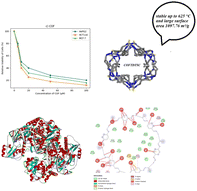
A new imine-linked covalent organic framework (COFTDTSC) was synthesized from terephthaldehyde and thiosemicarbazide under solvothermal conditions. The obtained material exhibited excellent chemical and thermal stability up to 625 °C, along with a high surface area of 1097.76 m2 g−1 and an average pore size of ∼1.18 nm. Scanning electron microscopy (SEM) revealed an irregular, stone-like morphology distinct from the starting materials, confirming successful polymerization and framework formation. The anticancer potential of COFTDTSC was evaluated against three human cancer cell lines (HCT-116, HepG-2, and MCF-7), demonstrating notable cytotoxic activity with IC50 values ranging from 10.28 to 18.04 µM, in comparison with the standard drugs doxorubicin and sorafenib. Molecular docking supported these results, revealing that COFTDTSC had the strongest binding affinity (−9.1 kcal mol−1) and stable interactions within human topoisomerase IIα, supported by multiple hydrogen bonding and hydrophobic interactions within the active site. Density Functional Theory (DFT) calculations further examined the electronic structure and reactivity of the monomers and the COF. Polymerization into COFTDTSC reduced the energy gap and increased electronic softness, enhancing molecular reactivity. The COF exhibited delocalized charge density, a moderate dipole moment, and strong electron-acceptor properties, suggesting potential for biological interactions, such as DNA binding and enzyme inhibition. From a green chemistry perspective, the design of COFTDTSC integrates bioactive building blocks within a stable, porous organic framework, offering a promising platform for sustainable anticancer material development. These findings highlight COFTDTSC as a multifunctional candidate for future biomedical applications.
 Please wait while we load your content...


