


 PLATFORM UPDATE:

Gauging lipid vulnerabilities in mRNA-LNPs under various environmental stressors through TIMS-TOF analysis
 †*ac
†*ac
Abstract
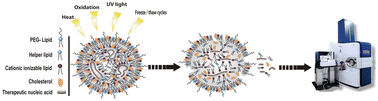
The long-term stability of mRNA lipid nanoparticles (LNPs) is governed by the chemical resilience of their constituent lipids, yet the specific degradation pathways triggered by real-world stressors remain poorly defined. Here, we systematically mapped lipid-specific vulnerabilities in mRNA-LNPs formulated with three clinically relevant ionizable lipids, DLin-MC3-DMA (MC3), SM-102, and ALC-0315, under controlled thermal, photo-oxidative, and mechanical stress conditions. Luciferase-encoding mRNA-LNPs were prepared via microfluidic mixing using a standardized composition of ionizable lipid, helper phospholipid, cholesterol, and PEG-lipid, and then exposed, for 72 hours, to mild heat (28 °C), ultraviolet (UV, 360 nm) irradiation, hydrogen peroxide-mediated oxidation, or repeated freeze–thaw cycling. Ultra-high-pressure liquid chromatography coupled with trapped ion mobility time-of-flight mass spectrometry (UHPLC-TIMS-TOF MS) enabled high-resolution, structure-specific profiling of intact lipids and degradation products. We show that UV and oxidative stress, but not modest heat or freeze–thaw cycling, induce pronounced and lipid-dependent chemical degradation, including headgroup oxidation, ester hydrolysis, and bond cleavage within MC3, SM-102, and ALC-0315, as well as the helper lipid 1,2-distearoyl-sn-glycero-3-phosphocholine (DSPC). These modifications occur at levels and sites consistent with impaired endosomal escape chemistry, despite preservation of particle size, encapsulation efficiency, and conventional biophysical readouts. By directly linking defined environmental stressors to discrete ionizable lipid oxidation pathways, this work provides a mechanistic framework for understanding hidden failure modes in mRNA LNP formulations and establishes UHPLC-TIMS-TOF MS as a powerful tool for predictive stability assessment and rational design of more robust, regulation-ready mRNA therapeutics.
 Please wait while we load your content...


