


 PLATFORM UPDATE:


DFT study of halogenated InTeX (X = Cl, Br and I) monolayers: promising 2D materials for nanoelectronics

Abstract
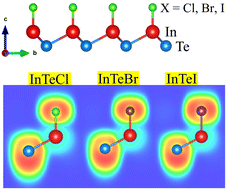
First-principles calculations were performed to investigate the structural, electronic, mechanical, and spintronic properties of InTeX (X = Cl, Br, and I) monolayers formed via full halogenation of pristine InTe. Halogenation induces a structural transformation from the four-sublayer Te–In–In–Te configuration to a three-sublayer Te–In–X geometry, accompanied by the formation of polar covalent In–X bonds and the suppression of metallic In–In interactions. The resulting monolayers preserve a buckled hexagonal lattice and exhibit enhanced thermodynamic, thermal, and dynamical stability. InTeX monolayers display moderate Young's moduli (22.18–25.26 N m−1), isotropic in-plane elastic behavior, and Poisson's ratios from 0.31 to 0.32, rendering them promising candidates for flexible and wearable nanoelectronic applications. The electronic band structures reveal tunable direct band gaps and strong, anisotropic Rashba spin–orbit coupling, with Rashba parameters αR ranging from 0.81 to 1.04 eV Å, indicating potential for spintronic and optospintronic devices. Importantly, charge-carrier mobilities were evaluated by explicitly accounting for phonon and impurity scattering, yielding realistic values consistent with experimental expectations and underscoring the importance of accurate mobility modeling for device performance. Overall, the combination of structural stability, tunable electronic properties, robust spin–orbit effects, and reliable carrier transport makes InTeX monolayers highly promising materials for future research in flexible electronics, spintronics, and multifunctional two-dimensional nanomaterials.
 Please wait while we load your content...


