


 PLATFORM UPDATE:


Assisted evaluation of aniline's in silico toxicity using artificial intelligence and its simultaneous determination as a toxic impurity with widely used cardiovascular drugs using a green micellar chromatographic method
 *a
Soad S.
Abd El-Hay,
b
Youstina Mekhail
Metias,
b
Mohamed Adel
Said
a
and
Michael Gamal
Fawzy
a
*a
Soad S.
Abd El-Hay,
b
Youstina Mekhail
Metias,
b
Mohamed Adel
Said
a
and
Michael Gamal
Fawzy
a
Abstract
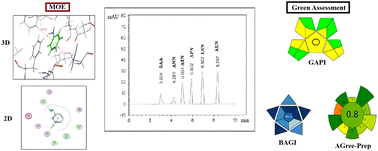
The safety of pharmaceutical products is critically influenced by the presence of impurities and degradation products. Aniline (ANN) is a very toxic degradation product of atorvastatin (ATN), which can cause life-threatening diseases such as methemoglobinemia. For the first time, a comprehensive artificial intelligence study using molecular docking was applied to assess the ANN-induced methemoglobinemia by simulating different binding energies in different pockets of cytochrome P450 (CYP 1A2), revealing the most suitable position leading to toxicity. Moreover, environmental concerns have become increasingly important due to the toxic effects of the excessive use of organic solvents in chromatographic separation systems. Accordingly, greener surfactant systems comprising sodium dodecyl sulfate (SDS) and polyoxyethylene-23-lauryl ether (Brij-35) were employed as safer alternatives were used for the quantitation of ANN in the presence of salicylic acid as an aspirin impurity alongside four widely used cardiovascular drugs of aspirin (APN), atenolol (AEN), atorvastatin calcium (ATN), and losartan potassium (LSN) in pure form and pharmaceuticals. The method validation was done according to the International Conference for Harmonisation (ICH) guidelines with linearity ranges of (10–200), (5–140), (5–100), (5–130), (0.5–40), and (0.5–30) µg mL−1 for APN, AEN, ATN, LSN, SAA, and ANN, respectively, and the results obtained were highly accurate. The greenness of the proposed method was ascertained using the green analytical procedure index: score (0.80), blue applicability grade index: score (0.85), and the Analytical GREEnness calculator. A statistical comparison between the results of our study and the reported method showed no significant difference in precision or accuracy.
 Please wait while we load your content...


