


 PLATFORM UPDATE:


Variovoracins: new glycolipopeptide biosurfactants identified by surfactant screening and genome mining
 †*abe
Douglas H.
Marchbank,
†ab
Fabrice
Berrué,
d
Hebelin
Correa,
a
Alyssa L.
Grunwald,
a
Russell G.
Kerr
abc
†*abe
Douglas H.
Marchbank,
†ab
Fabrice
Berrué,
d
Hebelin
Correa,
a
Alyssa L.
Grunwald,
a
Russell G.
Kerr
abc
Abstract
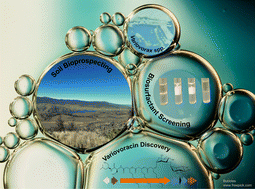
Increasing awareness of the environmental issues associated with conventional surfactants has incentivized the chemical industry to develop more sustainable alternatives such as biosurfactants, which are a class of surface-active molecules produced by microorganisms. Biosurfactants are environmentally benign and have the potential to be manufactured sustainably through microbial fermentations fed by renewable feedstocks, unlike conventional surfactants produced from petrochemical feedstocks. Biosurfactants therefore have an important role in the development of sustainable surfactants for consumer and industrial use. To identify new biosurfactants, we screened a microbial library for strains producing emulsifiers. Analysis of active microbial extracts by UHPLC-HRMS led to the identification of the variovoracins, a new class of glycolipopeptide biosurfactants, from Variovorax paradoxus RKNM0096. Their chemical structures were elucidated by NMR spectroscopy, and the absolute configuration was determined through multiple chiral derivatization techniques. Meanwhile, tandem mass spectrometry revealed the presence of numerous homologues differing in the position of the C8 or C12 acyl chain. Genome sequencing and bioinformatic analysis identified a candidate biosynthetic gene cluster (BGC) whose role in variovoracin biosynthesis was confirmed by functional characterization of a key rhamnosyltransferase, which was shown to efficiently convert a mono-rhamnosylated pathway intermediate to the final di-rhamnosylated variovoracin. Genome mining identified 123 BGCs homologous to the variovoracin cluster distributed in 12 genera within the Pseudomonadota, but concentrated within the Variovorax genus. Production of variovoracin analogues was demonstrated in two strains predicted to produce mono-rhamnosylated congeners, further validating the assignment of the variovoracin BGC. Despite their structural similarity to the rhamnolipids, the characteristic curvature (Cc) of the variovoracins has the opposite sign, indicating that their non-ionic and hydrophobic properties confer unique functional characteristics and consequently different surfactant applications.
 Please wait while we load your content...


