


 PLATFORM UPDATE:


High-temperature physical properties of tungsten: implications for near-field thermophotovoltaic energy conversion
 *a
and
Anh D.
Phan
bc
*a
and
Anh D.
Phan
bc
Abstract
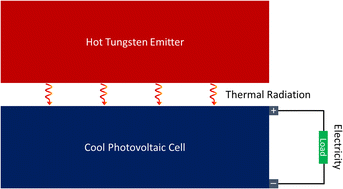
Tungsten plays a crucial role in the development of near-field thermophotovoltaic devices. However, available information about tungsten is insufficient to model radiative heat transfer at elevated temperatures. In this study, we develop a statistical theory to evaluate finite-temperature effects on the physical properties of tungsten up to 2000 K, corresponding to extreme conditions in practical emitters. First, the moment expansion technique is applied to calculate the atomic volume, the mechanical modulus, and the Debye temperature. Quasi-harmonic and anharmonic contributions are clarified via simple analytical formulas for free energies. Then, we utilize these thermodynamic quantities to deduce the electrical resistivity from the Bloch–Grüneisen law and the dielectric function from the Drude–Lorentz model. Our calculations are in good agreement with previous experiments. Finally, based on fluctuational electrodynamics, we reconsider energy-conversion processes in a representative system made of tungsten and GaSb. Both radiative and electric power densities will be severely underestimated if the thermal variation of input parameters is ignored. This result suggests that experimental and computational databases need to be expanded from low to high temperatures before actualizing the potential applications of near-field thermophotovoltaics.
 Please wait while we load your content...


