


 PLATFORM UPDATE:


Strategic integration of carbon nanotubes over the redox-active surfaces of FeCo2S4 as an electrode material for developing high-efficiency supercapacitor devices

Abstract
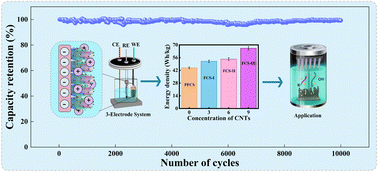
Accelerating both electrical and ionic conductivity of spinel sulfides (AB2S4) presents a challenge that demands an urgent solution to improve their electrochemical properties for effective energy storage strategies. The need to develop electrode materials has been a significant step forward for the scientific community in enhancing electrochemical performance for supercapacitor applications. Therefore, incorporating carbon nanotubes (CNTs) into spinel sulfides could be an excellent option, serving as a model for new electrodes. To investigate this, FeCo2S4 spinel sulfide was combined with CNTs via hydrothermal and solvothermal synthesis. A series of FeCo2S4/CNTs composites with 0, 3, 6, and 9 wt% CNTs were successfully prepared and confirmed via X-ray diffraction (XRD) technique. Meanwhile, Field Emission Scanning Electron Microscopy (FESEM) revealed topographical features, including web-like structures of the highest CNTs treated sample, with significantly improved interconnectivity that enhances ion and electron transport. The FeCo2S4/9% CNTs electrode delivered an efficient electrochemical response, with a specific capacity of 1059.62 C g−1 at 10 A g−1, an energy density of 66.22 Wh kg−1, and a power density of 2250 W kg−1, while also retaining 98.8% of its initial capacity after 10k cycles. Electrochemical analyses further confirmed a hybrid charge-storage process, with low charge transfer resistance (5.15 Ω), stable conductivity (0.13 S cm−1), and a short relaxation time (0.010 s), yielding a maximum cation mobility of 3.81 × 10⁻¹⁰ m2 V−1 s−1 and a rate constant of 6.03 × 10⁻⁸ cm s−1 at 5.82 mA g−1. The fabricated asymmetric pseudocapacitive device facilitated the maximum energy and power density values of around 63.15 Wh kg−1 and 10 800 W kg−1, respectively, in 1 M KOH electrolyte. These findings suggest that CNT-assisted FeCo2S4 nanocomposites exhibit remarkable redox activity and transport properties, making them promising electrodes for high-performance supercapacitors.
 Please wait while we load your content...


