


 PLATFORM UPDATE:


Spectrophotometric detection of Fe3+ ions using garlic-derived alliin and bovine serum albumin-stabilized AgNPs

Abstract
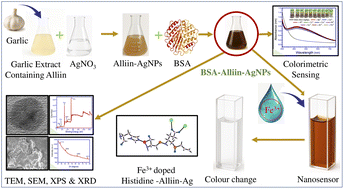
Iron (Fe) is essential for biological systems, with ferric (Fe3+) and ferrous (Fe2+) states possessing biological significance. Imbalances in Fe3+ levels can lead to major health concerns. It necessitates accurate and specific detection of Fe3+ in drinking water sources. This study offers an eco-friendly, cost-effective colorimetric nanosensor for Fe3+ detection using silver nanoparticles (AgNPs) synthesized from garlic-derived alliin and bovine serum albumin (BSA). The nanoparticles were studied using UV-visible spectroscopy, X-ray photoelectron spectroscopy (XPS), X-ray diffraction (XRD), scanning electron microscopy (SEM), transmission electron microscopy (TEM) and energy dispersive X-ray spectroscopy (EDS). The AgNPs exhibited a plasmonic peak at 420 nm and TEM revealed spherical particles with an average diameter of 12.17 ± 0.60 nm. XPS analysis validated the binding energies of S 2p, C 1s, Ag 3d, N 1s, and O 1s. XRD showed that the AgNPs have a face-centered cubic (FCC) structure. The sensor has a detection limit of 5.54 fM for Fe3+, with the highest sensitivity at pH 4 (68.80 ± 1.05% relative activity). Kinetic analysis indicated that zero-order kinetics provided the best fit under the given conditions. Computational modelling indicates a stable Fe3+ interaction with the NH group of BSA's histidine and the CHO group of alliin, with a binding energy of 16.1 kcal mol−1. This supports the formation of a stable Ag-alliin-Fe complex. The sensor effectively detects Fe3+ in real water samples, underscoring its practical potential for environmental monitoring.
 Please wait while we load your content...


