


 PLATFORM UPDATE:


Selective recovery of silver by thiuram disulfide-modified cellulose

Abstract
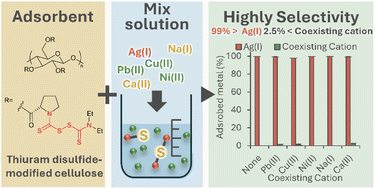
A thiuram disulfide–modified cellulose adsorbent (TDMC) was developed for the highly selective recovery of silver ions from aqueous solutions. The adsorbent was synthesized by introducing thiuram disulfide functional groups onto a cellulose backbone to selectively adsorb Ag(I). Batch adsorption experiments were conducted to evaluate the adsorption performance and selectivity under various conditions. The maximum adsorption capacity of TDMC for Ag(I), estimated from the Langmuir model, was 3.61 mmol g−1 at pH 1.0. Remarkably, TDMC exhibited outstanding selectivity toward Ag(I) even in the presence of high concentrations of competing metal ions. When Ag(I) coexisted with Cu(II), Pb(II), Zn(II), Ni(II), Ca(II), K(I), Mg(II), and Na(I) at 2000-fold higher total concentrations, the adsorption percentage of Ag(I) remained 99.0%, comparable to that under single-metal conditions, whereas those of other ions were below 2.5%. X-ray photoelectron spectroscopy revealed that adsorbed Ag atoms were bonded to sulfur atoms of the thiuram disulfide groups. Furthermore, fast atom bombardment mass spectrometry was performed on a low-molecular-weight thiuram–Ag(I) complex that exhibits spectroscopic features similar to those of Ag–TDMC, allowing us to determine the molecular weight and structural characteristics of the complex. These findings demonstrate that TDMC possesses an exceptional ability to selectively capture Ag(I) through specific Ag–S coordination, providing a simple and efficient approach for silver recovery.
 Please wait while we load your content...


