


 PLATFORM UPDATE:


Efficient water electrolysis with Ce-WO3@NiCo bifunctional catalysts

Abstract
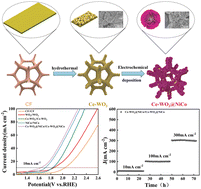
The development of highly efficient non-precious metal electrocatalysts with excellent activity and durability for overall water splitting remains a critical challenge for advancing sustainable hydrogen production. In this work, Ce-WO3@NiCo nanoflower architectures are achieved on copper foam (CF) substrates through hydrothermal and electrodeposition methods. Ce doping can improve the activity of catalysts due to the adjustment of the electronic structure, thereby increasing the conductivity. In addition, an electrocatalyst with a three-dimensional (3D) heterostructure can increase the number of active sites, and this multi-component synergistic effect optimizes the electronic structure while regulating the adsorption/desorption process of electrochemical intermediates through interface engineering. The Ce-WO3@NiCo catalyst exhibits excellent electrocatalytic activity in the alkaline electrolyte, with overpotentials of 56 mV and 323 mV for the hydrogen evolution reaction (HER) and oxygen evolution reaction (OER) respectively, at a current density of 10 mA cm−2. In addition, Ce-WO3@NiCo requires only 1.624 V to achieve overall water splitting at 10 mA cm−2. Meanwhile, it maintains long-term stability for 72 h at current densities of 10, 100, and 300 mA cm−2. This research offers a viable approach for constructing highly stable and low-cost self-supported bifunctional electrocatalysts through electronic structure modulation.
 Please wait while we load your content...


