


 PLATFORM UPDATE:


Fabrication of potential environmentally friendly 3D printing biocomposite filament based on poly(lactic acid) and cellulose fibers from agricultural waste
 *a
Nguyen Thanh
Huy
bc
*a
Nguyen Thanh
Huy
bc
Abstract
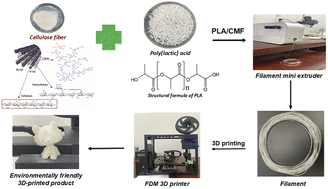
This study focuses on the fabrication of biocomposites based on poly(lactic acid) (PLA) and cellulose fibers (CMF) extracted from corn cob agricultural waste using a simple alkaline hydrogen peroxide (HPK) treatment. The HPK process was optimized by varying the ratio of weight of raw material and volume of used chemicals (wt/V), reaction temperature, and reaction time. The extracted cellulose fibers were used as reinforcing agents in the PLA matrix to improve the mechanical properties of the biocomposites. To enhance compatibility and interfacial adhesion between the cellulose fibers and the polymer matrix, the fiber surface was chemically modified using rice bran oil (RBO), an environmentally friendly modification agent. Scanning electron microscopy (SEM) and Fourier-transform infrared spectroscopy (FTIR) analyses confirmed the effective removal of surface impurities, hemicellulose, and lignin from the corn cobs after HPK treatment. X-ray diffraction (XRD) results showed that the treated cellulose fibers exhibited a higher crystallinity index than the raw material, while thermogravimetric analysis (TGA) demonstrated improved thermal stability of the cellulose fibers. Differential scanning calorimetry (DSC) indicated that the incorporation of RBO-modified cellulose fibers enhanced the crystallization rate of PLA, and rheological measurements revealed higher viscosity of PLA/RBO1 biocomposites compared to neat PLA across the entire shear rate range. Tensile test results demonstrated that biocomposites containing RBO-modified cellulose fibers exhibited significantly improved mechanical properties, with the composite containing 1 wt% CMF achieving the highest performance. Furthermore, PLA/RBO1 composite filaments showed good printability via fused deposition modeling (FDM), highlighting their potential as environmentally friendly materials for 3D printing applications.
 Please wait while we load your content...


