


 PLATFORM UPDATE:


Fabrication and characterization of novel PLA/CH/GelMA/hydroxyapatite electrospun nanofibers for bone tissue regeneration
 *defgh
and
*defgh
and
Abstract
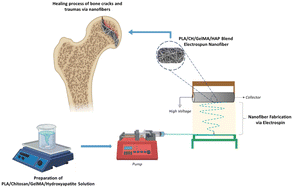
This study focuses on the fabrication and comprehensive characterization of electrospun nanofibrous scaffolds composed of polylactic acid (PLA), chitosan (CH), gelatin methacryloyl (GelMA), and varying concentrations of hydroxyapatite (HAP) nanoparticles (0.1, 0.3, and 0.5% w/v) for potential applications in bone tissue engineering. Unlike previous studies utilizing binary or ternary systems, this work introduces a novel quadri-composite scaffold designed to overcome individual material limitations through synergistic effects: PLA provides the mechanical backbone, chitosan ensures hydrophilicity and antimicrobial potential, GelMA enhances cell adhesion via RGD motifs, and HAP serves as the osteoconductive mineral phase. The structural, thermal, mechanical, swelling, degradation, and biological properties of the nanofibers were investigated using SEM, FT-IR, DSC, and tensile testing. Among the tested formulations, the nanofibers containing 0.3% HAP exhibited the most balanced properties, with a tensile strength of 0.50 ± 0.18 MPa and elongation at break of 14.82 ± 6.93%, indicating optimal mechanical flexibility. These fibers also demonstrated improved thermal stability, controlled swelling behavior, and a degradation profile suitable for bone healing. In vitro biocompatibility studies using human osteoblast (hFOB) cells showed that while lower HAP content supported initial attachment, significantly higher cell viability was observed on the 0.3% HAP scaffolds at day 7 (p < 0.0365), supporting their superior long-term osteoblast proliferation. Overall, PLA/CH/GelMA nanofibers containing 0.3% HAP offer a promising strategy for bone regeneration due to their ECM-mimetic structure, tunable biodegradability, mechanical resilience, and bioactivity. Future studies will focus on in vivo evaluation of these scaffolds for bone defect repair.
 Please wait while we load your content...


