Issue 8, 2026, Issue in Progress

Hypophosphite-assisted ball milling enables broadband self-trapped exciton emission in copper halides for self-powered smart windows

Abstract

Metal halide perovskites have shown remarkable potential in photovoltaic and optoelectronic applications due to their excellent light absorption, high defect tolerance, and long carrier diffusion lengths. In this study, we systematically investigate copper-based metal halides and introduce a hypophosphorous acid-assisted mechanochemical ball milling strategy to construct highly stable copper halide systems. Leveraging the broadband emission characteristics of self-trapped excitons (STE), we explore the controlled synthesis and optoelectronic applications of these materials. Using DPCu4Br6 (DP = p-phenylenediamine) as a representative compound, we achieved outstanding optical performance, including broadband emission (FWHM = 120 nm), minimal reabsorption, ultrahigh photoluminescence quantum yield (PLQY = 98.38%), and a long exciton lifetime of 47.62 µs. Remarkably, the material retained over 80% of its PLQY after six months of exposure to ambient air, demonstrating superior environmental stability. Based on these results, a 6 × 6 cm2 luminescent solar concentrator (LSC) was fabricated, achieving an optical conversion efficiency (ηopt) of 12.43%, and successfully integrated with electrochromic smart windows to enable self-powered light modulation through a synergistic system design.
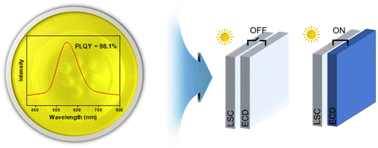
Graphical abstract: Hypophosphite-assisted ball milling enables broadband self-trapped exciton emission in copper halides for self-powered smart windows

Article information

Article type
Paper
Submitted
29 Oct 2025
Accepted
23 Jan 2026
First published
03 Feb 2026
This article is Open Access
Creative Commons BY-NC license

RSC Adv., 2026,16, 6960-6966

Hypophosphite-assisted ball milling enables broadband self-trapped exciton emission in copper halides for self-powered smart windows

Y. Xie, J. Zhang, B. Zhang, J. Liu, J. Ding, T. Gao, A. Chen, W. Wang, Y. Wang and A. Wang, RSC Adv., 2026, 16, 6960 DOI: 10.1039/D5RA08298F

This article is licensed under a Creative Commons Attribution-NonCommercial 3.0 Unported Licence. You can use material from this article in other publications, without requesting further permission from the RSC, provided that the correct acknowledgement is given and it is not used for commercial purposes.

To request permission to reproduce material from this article in a commercial publication, please go to the Copyright Clearance Center request page.

If you are an author contributing to an RSC publication, you do not need to request permission provided correct acknowledgement is given.

If you are the author of this article, you do not need to request permission to reproduce figures and diagrams provided correct acknowledgement is given. If you want to reproduce the whole article in a third-party commercial publication (excluding your thesis/dissertation for which permission is not required) please go to the Copyright Clearance Center request page.

Read more about how to correctly acknowledge RSC content.

Social activity

Spotlight

Advertisements