Issue 6, 2026, Issue in Progress

Functionalization of carbon nanospheres with curcumin, polyethylene glycol and folic acid: potential use as drug carriers

Abstract

This study reports the synthesis of carbon nanospheres (CNS) modified by anchoring curcumin (CUR), polyethylene glycol (PEG) and folic acid (FA) on their surface as a drug delivery system (DDS) for potential applications in cancer therapy. CNS were synthesized via chemical vapor deposition (CVD) while CUR and PEG were anchored onto their surface by impregnation, and FA conjugation was achieved using N-hydroxysuccinimide (NHS) and 1-ethyl-3-(3-dimethylaminopropyl)carbodiimide (EDC) as coupling agents. The modified CNS underwent comprehensive characterization using scanning electron microscopy (SEM), Fourier-transform infrared (FTIR) spectroscopy, Raman spectroscopy, thermogravimetric analysis (TGA), X-ray diffraction (XRD), zeta potential measurements, and release profile analysis. The functionalization of CNS was successfully achieved, yielding particles with an average size of 150 nm, a polydispersity index (PDI) of 0.215, zeta potential of −27.7 mV and loading efficiency (LE%) of 63.63 ± 1.61%. Release profile experiments demonstrated a sustained pH-responsive drug release of 3.3% at pH 7.4 vs. 4.3% at pH 5.8 after 48 h.
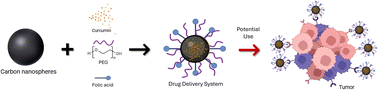
Graphical abstract: Functionalization of carbon nanospheres with curcumin, polyethylene glycol and folic acid: potential use as drug carriers

Supplementary files

Article information

Article type
Paper
Submitted
06 Nov 2025
Accepted
05 Jan 2026
First published
23 Jan 2026
This article is Open Access
Creative Commons BY-NC license

RSC Adv., 2026,16, 4859-4868

Functionalization of carbon nanospheres with curcumin, polyethylene glycol and folic acid: potential use as drug carriers

L. De Sales, S. A. Bernal-Chávez and J. Campos-Delgado, RSC Adv., 2026, 16, 4859 DOI: 10.1039/D5RA08562D

This article is licensed under a Creative Commons Attribution-NonCommercial 3.0 Unported Licence. You can use material from this article in other publications, without requesting further permission from the RSC, provided that the correct acknowledgement is given and it is not used for commercial purposes.

To request permission to reproduce material from this article in a commercial publication, please go to the Copyright Clearance Center request page.

If you are an author contributing to an RSC publication, you do not need to request permission provided correct acknowledgement is given.

If you are the author of this article, you do not need to request permission to reproduce figures and diagrams provided correct acknowledgement is given. If you want to reproduce the whole article in a third-party commercial publication (excluding your thesis/dissertation for which permission is not required) please go to the Copyright Clearance Center request page.

Read more about how to correctly acknowledge RSC content.

Social activity

Spotlight

Advertisements