


 PLATFORM UPDATE:


Enhancing the electrochemical performance of trimetallic sulfide through metal-oxide nanocomposite engineering for high-performance supercapacitors

Abstract
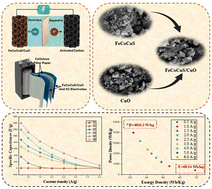
Supercapacitors, considered a potential energy storage device, can address the long-awaited problem of the energy crisis by storing energy for efficient, rapid, and sustainable utilization across diverse applications, from portable electronics to large-scale power systems. Herein, we have prepared a novel nanocomposite material via a novel ultrasonication-assisted solvothermal approach, combining the Fe0.67Cu0.22Co0.11S nanoparticles and CuO in different weight ratios. X-ray diffraction, scanning electron microscopy, and Fourier transform infrared spectroscopy analyses confirmed the successful synthesis of the targeted nanocomposites. Electrochemical evaluation revealed that the FeCuCoS/CuO 5 : 1 composition (denoted as U5), identified as optimal material, exhibited a remarkable specific capacitance of 1407 F g−1 at 0.7 A g−1, corresponding to enhancements of 3.9-fold and 120-fold compared to pristine Fe0.67Cu0.22Co0.11S and CuO, respectively. Furthermore, the asymmetric supercapacitor device based on U5 demonstrated superior electrochemical performance, delivering a specific capacity of 311 C g−1 at 0.5 A g−1, an energy density of 70 Wh kg−1, a power density of 4800 W kg−1, a coulombic efficiency of 97.1%, and a long-term cycling stability of 92.86% after 3000 cycles. Dunn's model analysis indicated that charge storage was predominantly capacitive (51.3% at 10 mV s−1), while power-law fitting yielded b-values of 0.71–0.80, indicating hybrid supercapacitor behavior. Overall, Fe0.67Cu0.22Co0.11S/CuO nanocomposites demonstrated durable, high-performance characteristics for advanced energy storage applications.
 Please wait while we load your content...


