


 PLATFORM UPDATE:


Sonochemical synthesis and characterization of Tb2Cu2O5 nanostructures and their application as a nano-photocatalyst for the degradation of water-soluble organic pollutants under visible light

Abstract
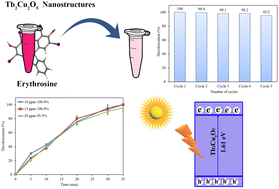
In this research, nanostructured Tb2Cu2O5 was synthesized using ultrasonic-assisted techniques with copper and terbium nitrates (in the presence of tetraethylenepentamine as a chelating and surface-modifying agent). The synthesis conditions were systematically optimized by varying the sonication power and duration. The optimal condition was achieved at a sonication power of 60 W for 15 min, resulting in phase-pure Tb2Cu2O5 nanostructures with a uniform morphology. The FESEM images also indicated the presence of well-dispersed quasi-spherical Tb2Cu2O5 nanostructures with uniform morphology. The photocatalytic performance of the synthesized Tb2Cu2O5 was evaluated using visible-light irradiation in the presence of several organic dyes, including erythrosine (ER), eriochrome black T (ET), methylene blue (MB), methyl orange (MO), rhodamine B (RhB), and methyl violet (MV). The degradation efficiency for ER was the highest (100.0% in 35 min), followed by that for ET (50.0% in 100 min), with lower degradation efficiencies for all other dyes. The photocatalytic mechanism was demonstrated to be influenced by the dye concentration, amount of catalyst, and pH of the solution. Radical scavenger experiments indicated that the radical mechanism was predominantly facilitated by the superoxide (˙O2−) and hydroxyl radicals (˙OH) while photogenerated holes had a lesser contribution. Tb2Cu2O5 exhibited excellent photostability, retaining 95.2% of its degradation efficiency after five reuse cycles. Furthermore, with a narrow bandgap of ∼1.61 eV, high efficiency, and excellent durability, the synthesized Tb2Cu2O5 could be a viable candidate for visible-light-driven photocatalytic water treatment.
 Please wait while we load your content...


