Issue 3, 2026

Ternary transition metal Co-Fe-Ni sulfide as a high-performance anode in microbial fuel cells

Abstract

The development of high-performance anode materials remains a critical challenge in advancing microbial fuel cells (MFCs). In this work, we present a novel strategy employing ternary transition metal Co-Fe-Ni sulfides to overcome the inherent trade-off between catalytic activity and structural stability commonly observed in conventional polymetallic sulfides. Through a facile one-pot solvothermal approach, we synthesized low-crystallinity CoFeNiSx (Co-Fe-Ni) ternary sulfides with precisely tunable Co/Fe/Ni molar ratios. When integrated as an MFC anode, the optimized Co-Fe-Ni sulfide delivered a maximum power density of 3915 mW m−2 using Escherichia coli (E. coli) as the biocatalyst, representing an 8.4% enhancement over its binary CoFeSx (Co-Fe) analogue. This performance exceeds that of most previously reported carbon-based anodes. The synthesized transition metal sulfides combine ease of fabrication with outstanding electrocatalytic efficiency. Our findings highlight the underexplored potential of ternary transition metal sulfides in engineering next-generation bioelectrochemical interfaces.
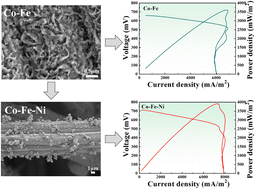
Graphical abstract: Ternary transition metal Co-Fe-Ni sulfide as a high-performance anode in microbial fuel cells

Supplementary files

Article information

Article type
Paper
Submitted
17 Nov 2025
Accepted
22 Dec 2025
First published
08 Jan 2026
This article is Open Access
Creative Commons BY-NC license

RSC Adv., 2026,16, 2205-2212

Ternary transition metal Co-Fe-Ni sulfide as a high-performance anode in microbial fuel cells

Q. Guo, J. Ma, W. Lu, Y. Wang, E. Luo, H. Xiao, L. Zhang, H. Wu, T. Hu and J. Jia, RSC Adv., 2026, 16, 2205 DOI: 10.1039/D5RA08874G

This article is licensed under a Creative Commons Attribution-NonCommercial 3.0 Unported Licence. You can use material from this article in other publications, without requesting further permission from the RSC, provided that the correct acknowledgement is given and it is not used for commercial purposes.

To request permission to reproduce material from this article in a commercial publication, please go to the Copyright Clearance Center request page.

If you are an author contributing to an RSC publication, you do not need to request permission provided correct acknowledgement is given.

If you are the author of this article, you do not need to request permission to reproduce figures and diagrams provided correct acknowledgement is given. If you want to reproduce the whole article in a third-party commercial publication (excluding your thesis/dissertation for which permission is not required) please go to the Copyright Clearance Center request page.

Read more about how to correctly acknowledge RSC content.

Social activity

Spotlight

Advertisements