


 PLATFORM UPDATE:


Electrochemical behavior and electrolysis of Ru(iii) in molten salts

Abstract
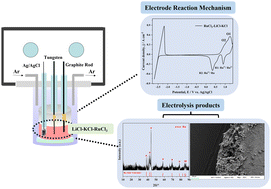
The yield of 103Ru in molten salt reactors is quite substantial and 103Ru holds significant potential applications in nuclear medicine. The electrochemical method is a promising technique for extracting 103Ru from molten salt reactor fuels. To investigate the electrolytic separation of 103Ru in molten salts, this paper employed cyclic voltammetry (CV) and square wave voltammetry (SWV) to focus on the electrochemical behavior of Ru(III) at an inert tungsten electrode in LiCl–KCl. The results indicate that the reduction process of Ru ions in LiCl–KCl molten salt involves a two-step reaction: Ru(III) → Ru(II) → Ru(0). The diffusion coefficient of Ru ions was determined using cyclic voltammetry to be 1.65 × 10⁻⁶ cm2 s−1. Constant-potential electrolysis was conducted at −2.5 V to obtain the electrolytic product, which was characterized by X-ray diffraction (XRD) and scanning electron microscopy with energy-dispersive spectroscopy (SEM-EDS). The deposited product was primarily composed of metallic ruthenium. According to inductively coupled plasma optical emission spectroscopy (ICP-OES) analysis, the extraction efficiency of Ru(III) ions on the nickel electrode reached 88.92%. The current efficiency was 58.93% for constant-potential electrolysis for 2 h. This study demonstrates that the separation of Ru by electrochemical methods in molten salts is feasible.
 Please wait while we load your content...


