Issue 3, 2026

Highly efficient Cr(vi) removal from water using deep eutectic solvents: a sustainable and comprehensive approach

Abstract

Addressing the persistent challenge of hexavalent chromium (Cr(VI)) pollution, this study introduces a sustainable extraction strategy using a novel hydrophobic deep eutectic solvent (HDES) composed of acetic acid and tetraoctylammonium bromide. Under optimized conditions (1 : 4 molar ratio), the HDES exhibited robust extraction capabilities, removing over 95% of Cr(VI) across a broad pH window (2–10). The extraction mechanism was best described by the pseudo-second-order kinetic model, while thermodynamic parameters confirmed a spontaneous and endothermic process (ΔH° = 38.21 kJ mol; ΔG° = −16.88 kJ mol−1). Notably, the method achieved a high enrichment factor of 87-fold in real wastewater samples. The environmental friendliness of the protocol was validated by an AGREE score of 0.76. This work represents the first successful application of an acetic acid-based HDES for Cr(VI) removal, establishing a scalable, efficient, and green methodology for environmental remediation.
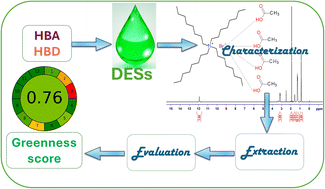
Graphical abstract: Highly efficient Cr(vi) removal from water using deep eutectic solvents: a sustainable and comprehensive approach

Supplementary files

Transparent peer review

To support increased transparency, we offer authors the option to publish the peer review history alongside their article.

View this article’s peer review history

Article information

Article type
Paper
Submitted
11 Nov 2025
Accepted
31 Dec 2025
First published
14 Jan 2026
This article is Open Access
Creative Commons BY-NC license

RSC Adv., 2026,16, 2767-2782

Highly efficient Cr(VI) removal from water using deep eutectic solvents: a sustainable and comprehensive approach

T. N. Huynh, D. T. Nguyen, H. H. Phuong Uyen Pham, A. D. Trinh and Q. H. Tran, RSC Adv., 2026, 16, 2767 DOI: 10.1039/D5RA08693K

This article is licensed under a Creative Commons Attribution-NonCommercial 3.0 Unported Licence. You can use material from this article in other publications, without requesting further permission from the RSC, provided that the correct acknowledgement is given and it is not used for commercial purposes.

To request permission to reproduce material from this article in a commercial publication, please go to the Copyright Clearance Center request page.

If you are an author contributing to an RSC publication, you do not need to request permission provided correct acknowledgement is given.

If you are the author of this article, you do not need to request permission to reproduce figures and diagrams provided correct acknowledgement is given. If you want to reproduce the whole article in a third-party commercial publication (excluding your thesis/dissertation for which permission is not required) please go to the Copyright Clearance Center request page.

Read more about how to correctly acknowledge RSC content.

Social activity

Spotlight

Advertisements