


 PLATFORM UPDATE:


Photocatalytic oxidation of arsenic(iii) in aqueous media: a mini-review

Abstract
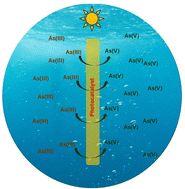
Prolonged exposure to arsenic (As)-contaminated water poses a serious risk to human health due to its high toxicity, which can cause skin lesions and, in the most severe cases, various types of cancer. It is therefore imperative to develop effective strategies to remove it. However, conventional removal methods have significant limitations for eliminating this metalloid, prompting research into sustainable alternatives, including photocatalytic oxidation. This mini-review examines the most recent advances in photocatalytic oxidation of As(III) to As(V) species, with a special emphasis on the primary photocatalysts employed, the reaction mechanisms involved, and the operating parameters that determine process efficiency. Various photocatalysts, based on both metal oxides and carbonaceous materials, have shown high efficiencies under ultraviolet and visible irradiation. Likewise, strategies to optimize photocatalytic performance have been explored, such as the construction of heterojunctions and doping with metallic and non-metallic elements, which facilitate charge separation and enhance light absorption, thereby promoting the generation of reactive oxygen species (ROS). Among these, hydroxyl radicals (˙OH) and superoxide radicals (˙O2−) have been shown to play a key role in the oxidation of As(III), achieving 100% conversion in a matter of minutes or hours. Finally, recent advances, the advantages and limitations of different photocatalytic approaches, and the main challenges associated with developing robust, economically viable systems for the treatment of arsenic-contaminated water are analyzed.
- This article is part of the themed collection: 2026 Reviews in RSC Advances
 Please wait while we load your content...


