Issue 9, 2026, Issue in Progress

Dual-activated fluorescent probe for the study of the mechanism of SO2 and NO in cisplatin resistance of nasopharyngeal carcinoma

Abstract

Cisplatin is widely used in the treatment of advanced nasopharyngeal carcinoma; however, its therapeutic application is often limited by a high incidence of drug resistance. Recent studies have demonstrated that nitric oxide (NO) and sulfur dioxide (SO2), acting as gaseous signaling molecules, exhibit anti-cisplatin resistance properties in tumor cells. Nevertheless, developing appropriate chemical tools to investigate the mechanisms underlying NO and SO2 mediated cisplatin resistance to cisplatin remains challenging. This study designed and synthesized a dual-responsive fluorescent probe to detect peroxynitrite (ONOO) and SO2, enabling them to be visualized within cells. Using this probe to detect and image ONOO and SO2 in cisplatin-resistant cell lines revealed that NO and SO2 combat cisplatin resistance by generating highly reactive ONOO and depleting intracellular glutathione. The IC50 values of cisplatin-resistant cells treated with NO and SO2 were significantly lower than those of the control group. These results indicate that HCy–ONOO–SO2 can serve as a powerful chemical tool for investigating the mechanisms of cisplatin resistance in nasopharyngeal carcinoma.
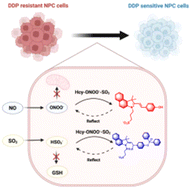
Graphical abstract: Dual-activated fluorescent probe for the study of the mechanism of SO2 and NO in cisplatin resistance of nasopharyngeal carcinoma

Supplementary files

Transparent peer review

To support increased transparency, we offer authors the option to publish the peer review history alongside their article.

View this article’s peer review history

Article information

Article type
Paper
Submitted
28 Oct 2025
Accepted
30 Jan 2026
First published
09 Feb 2026
This article is Open Access
Creative Commons BY-NC license

RSC Adv., 2026,16, 7936-7942

Dual-activated fluorescent probe for the study of the mechanism of SO2 and NO in cisplatin resistance of nasopharyngeal carcinoma

X. Wang, X. Li, X. Chen and D. Wang, RSC Adv., 2026, 16, 7936 DOI: 10.1039/D5RA08282J

This article is licensed under a Creative Commons Attribution-NonCommercial 3.0 Unported Licence. You can use material from this article in other publications, without requesting further permission from the RSC, provided that the correct acknowledgement is given and it is not used for commercial purposes.

To request permission to reproduce material from this article in a commercial publication, please go to the Copyright Clearance Center request page.

If you are an author contributing to an RSC publication, you do not need to request permission provided correct acknowledgement is given.

If you are the author of this article, you do not need to request permission to reproduce figures and diagrams provided correct acknowledgement is given. If you want to reproduce the whole article in a third-party commercial publication (excluding your thesis/dissertation for which permission is not required) please go to the Copyright Clearance Center request page.

Read more about how to correctly acknowledge RSC content.

Social activity

Spotlight

Advertisements