


 PLATFORM UPDATE:


Synthesis, characterization, and performance of the Fe-HApBio heterogeneous catalyst for electro-Fenton degradation of cefuroxime sodium
 *d
and
*d
and
Abstract
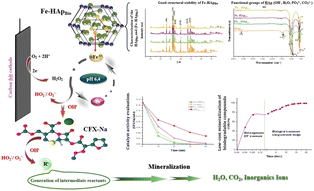
An efficient heterogeneous Electro-Fenton (EF) process was developed using a catalyst based on hydroxyapatite derived from bovine bone bio-waste (HApBio), doped with iron through ion exchange (Fe(x)-HApBio), for the degradation and mineralization of the antibiotic Cefuroxime Sodium (CFX-Na) in an aqueous medium. The materials were synthesized and characterized by different techniques including X-ray diffraction (XRD), Fourier transform infrared absorption spectroscopy (FTIR), scanning electron microscopy coupled with EDX (SEM-EDX) and X-ray fluorescence spectroscopy (XRF). These analyses demonstrated the high structural stability of HApBio despite iron doping, a homogeneous dispersion of iron, the presence of functional groups characteristic of hydroxyapatite such as hydroxyl ions OH−, H2O, PO43−, and CO32−, as well as a total iron content of 5.687 wt%. The catalytic activity of the catalyst was evaluated without any prior adjustment to the pH of the solutions. The results showed that an optimal doped iron content of 0.5%, with a catalyst concentration of 1 g L−1 applying a current of 400 mA, allowed total degradation to be achieved in 25 min and almost complete mineralization after 5 hours of electrolysis. Radical scavenging experiments using DMSO and chloroform confirmed that hydroxyl radicals (˙OH) were the primary oxidizing species, while hydroperoxyl (˙O2H) and superoxide (O2˙−) radicals were also present in the degradation process. To describe the formation pathways of these reactive species a reaction mechanism was proposed. Also, the catalyst demonstrated good stability after several reuse cycles. Moreover, heterogeneous EF treatment enhanced the biodegradability of the solution after 90 minutes, and therefore, allowed its subsequent low-cost biological treatment. After 17 days, aerobic biological post-treatment achieved almost complete mineralization, which indicated the overall efficiency, sustainability, and less energy consumption of the process.
 Please wait while we load your content...


