


 PLATFORM UPDATE:


Green and scalable surface functionalization of silicon quantum dots using water-soluble organic acids for sustainable hybrid materials

Abstract
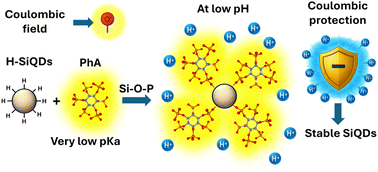
Silicon quantum dots (SiQDs) are attractive components for hybrid materials due to their inherently low toxicity, tunable optical properties, high lithium-specific capacity, and mechanical resilience. However, their integration is often hindered by the challenge of forming stable aqueous dispersions, due to their hydrophobic character and susceptibility to oxidation. In this work, we demonstrate that two common and environmentally benign acids, poly(acrylic acid) and phytic acid, can serve not only as dispersants but also as effective surface termination agents for SiQDs. In particular, the modification of surface hydrides was shown to lead to mixed covalent (Si–O–C, Si–O–P) and ionic bonding, resulting in enhanced colloidal stability. The robust covalent attachment and electrostatic stabilization by deprotonated acid groups was observed to effectively shield the terminated SiQDs from the highly reactive low-pH water. The shielding was monitored by photoluminescence measurements when initially H-terminated SiQDs showed minimal photoluminescence quenching at pH as low as 1.5 after treatment with phytic acid, compared to a 50% photoluminescence loss in untreated SiQDs. These beneficial effects were significantly diminished when mildly oxidized SiQDs underwent the treatment as a result of the lower availability of the reactive Si–H surface groups, or when both the acids were combined. Our findings show that the observed benefits arise from the reactive hydrogenated surface, often lacking in applications like Li-ion batteries and hybrid supercapacitors. Thus, this work highlights a green strategy for utilizing hydrogen-terminated SiQDs synthesized by non-thermal plasma, followed by benign acid-based functionalization in water, enabling nanohybrid synthesis without hazardous chemicals.
 Please wait while we load your content...


