


 PLATFORM UPDATE:


Solar-powered bioelectrochemical system for efficient cadmium remediation and recovery of reusable solids
 *ag
*ag
Abstract
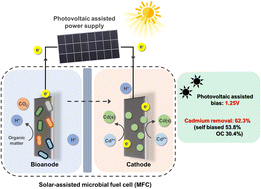
Cadmium (Cd) is a persistent industrial pollutant that poses severe environmental risks, necessitating remediation technologies that balance efficiency with energy sustainability. This study investigates a solar-powered bioelectrochemical system (PV-BES) as a low-energy strategy for Cd recovery, addressing limitations associated with conventional energy-intensive processes. In batch experiments, the PV-BES achieved 62.3% removal of dissolved Cd2+, outperforming the 53.8% efficiency of a self-biased microbial fuel cell. Electrochemical measurements combined with solid-phase characterization indicate that the solar-driven bias is consistent with localized interfacial alkalization, which favors the formation of crystalline Cd–O solids rather than continuous metallic Cd plating under near-neutral bulk pH conditions. These results suggest that coupling photovoltaics with bioanodes provides a synergistic, reagent-free pathway for cadmium immobilization and recovery. Overall, this work supports the potential of PV-assisted BES as a sustainable, low-energy approach for heavy metal remediation under mild aqueous conditions.
- This article is part of the themed collection: 2026 RSC Advances Popular Advances Collection
 Please wait while we load your content...


