


 PLATFORM UPDATE:


Thermal management of lithium-ion batteries: from single cooling to hybrid cooling
 *a
Yu
Bo
c
*a
Yu
Bo
c
Abstract
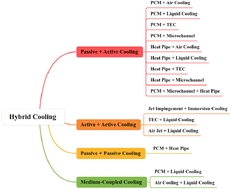
To address safety hazards from battery thermal runaway and efficiency losses caused by temperature non-uniformity, a systematic review is conducted on the evolution of thermal management technologies for lithium-ion batteries. Guided by the transition from single cooling strategies to composite systems that integrate and coordinate multiple approaches, a four-dimensional analytical framework has been established, encompassing air cooling, liquid cooling, phase-change material (PCM) cooling, and hybrid cooling technologies. Findings indicate that air-cooling systems retain a cost advantage in medium-to small-scale applications with relatively low energy density, where optimization efforts primarily focus on battery array configuration and airflow channel design. Liquid-cooling methods—such as cold-plate liquid cooling, immersion cooling, and heat-pipe cooling—have emerged as the mainstream solution in high-energy-density systems, with future research expected to address challenges related to cold-plate heat-exchange structures, fluid-distribution uniformity, and coolant selection. PCM cooling enables passive temperature regulation through the latent heat of solid–liquid phase transitions; however, its low thermal conductivity and phase-change hysteresis necessitate the synergistic application of advanced composite PCMs and enhanced heat-exchange structures. Multi-component hybrid cooling technologies, which simultaneously address temperature uniformity and rapid heat-dissipation demands under variable operating conditions such as high charge/discharge rates, are expected to become a major focus in the next stage of lithium-ion battery thermal management development.
- This article is part of the themed collection: 2026 Reviews in RSC Advances
 Please wait while we load your content...


