


 PLATFORM UPDATE:


Magnetized phyto-adsorbents for industrial dye removal: functionalization and mechanistic insights for sustainable wastewater remediation

Abstract
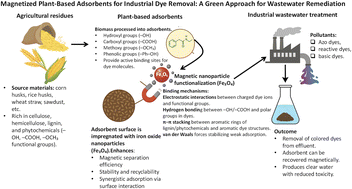
Industrial effluents from textile, leather, and dye manufacturing are major sources of water pollution, often containing synthetic dyes such as azo, reactive, and basic classes. These dyes are highly stable, toxic, and persistent, posing significant risks to both the ecosystem and human health. Conventional treatment methods, such as coagulation, oxidation, and activated carbon filtration, are often costly and operationally challenging, highlighting the need for sustainable alternatives. This review provides a comprehensive analysis of magnetized plant-based adsorbents, focusing on their composition, synthesis strategies, adsorption behaviour, and real-world potential. Incorporating Fe3O4 nanoparticles (NPs) into lignocellulosic biomass through co-precipitation, sol–gel, hydrothermal, or in situ embedding techniques enhances surface functionality, adsorption kinetics, and recovery efficiency. Adsorption mechanisms, modeled using Langmuir and Freundlich isotherms and pseudo-second-order kinetics, demonstrated the capacities of common dyes. Comparative studies show that magnetized biosorbents outperform non-magnetized systems in terms of adsorption efficiency, reusability, and operational feasibility. The review also addresses scale-up challenges, including nanoparticle leaching, regulatory compliance, and production costs, and highlights potential solutions such as green synthesis, MOF-biomass hybrids, and modular reactor designs. Overall, magnetized biosorbents represent a scalable, cost-effective, and environmentally responsible approach for industrial wastewater remediation, aligning with global sustainability goals.
- This article is part of the themed collection: 2026 Reviews in RSC Advances
 Please wait while we load your content...


