


 PLATFORM UPDATE:

Electrocatalytic properties of a carbothermically obtained composite based on vanadium nitridophosphide in the hydrogen evolution, oxygen evolution, and oxygen reduction reactions
 a
Yaroslav I.
Kurys
*a
and
a
Yaroslav I.
Kurys
*a
and
Abstract
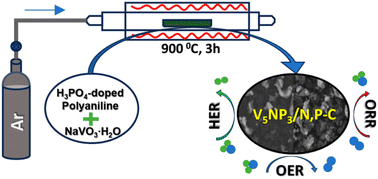
Hydrogen evolution reaction (HER), oxygen evolution reaction (OER), and oxygen reduction reaction (ORR) are the key electrochemical processes of hydrogen energy. Transition metal phosphides, nitrides, carbides, chalcogenides and their composites are promising non-precious metal electrocatalysts for these processes. Catalysts based on so-called early d-metal compounds, particularly V, attract less attention compared to those based on late transition metals (Ni, Co, Fe, etc.), which can generally be explained by their less competitive catalytic characteristics. However, combining V-containing compounds with late transition metal compounds or doping vanadium compounds with late d-metals allows for a significant increase in the performance of V-containing systems. This possibility, as well as the inherent electroconductive properties, ability to function in a wide pH range, and corrosion resistance of a number of vanadium compounds, determine the prospect of their use to create stable and effective electrocatalysts for HER, OER, and ORR. This work firstly shows that pyrolysis of polyaniline doped with phosphoric acid together with sodium metavanadate allows the production composite electrocatalyst for HER, OER and ORR based on vanadium nitridophosphide and N, P-co-doped carbon (V5NP3/N, P-C). The proposed approach is straightforward to implement and avoids the need for ammonia and toxic phosphorus compounds. It was found that in terms of its activity in all the studied processes, V5NP3/N, P-C exceeds the vast majority of known catalysts based on vanadium nitride or phosphide (provided that there are no additional late d-metals in their composition), and is characterized in HER by a Tafel slope (b) of ∼91 mV dec−1 and an overpotential at 10 mA cm−2 (η10) of ∼304 and 325 mV (in 1.0 M NaOH and 0.5 M H2SO4, respectively), in OER – η10 of ∼290 mV and b of ∼241 mV dec−1, in ORR – Eonset of ∼890 mV, E1/2 of ∼820 mV and b of ∼61 mV dec−1. Considering the high functional characteristics of V5NP3/N, P-C in HER, OER and ORR, as a composite based on an early d-metal compound, it can be used, in our opinion, for the formation within the framework of the proposed approach of competitive hybrid electrocatalysts with late d-metals or their compounds.
 Please wait while we load your content...


