


 PLATFORM UPDATE:


Preparation and characterization of fish skin gelatin and chitosan-based active dressings for skin wound healing
 *b
*b
Abstract
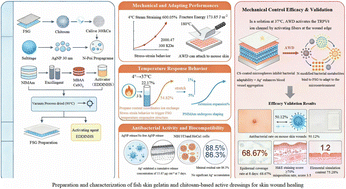
Skin wound healing remains challenging due to high infection rates and inefficient repair, with traditional dressings lacking mechanical durability and antibacterial control for dynamic wound environments. Herein, an active wound dressing (AWD) was fabricated using fish skin gelatin and chitosan via synergistic covalent (MBAA-PNIPAm) and ionic (Ca2+-FSG) crosslinking, integrated with silver nanoparticles (AgNPs), and optimized by finite element modeling. Studies have demonstrated that AWD exhibits outstanding mechanical properties: a tensile strain of 600.05% ± 25.32% and a maximum fracture energy of 2000.47 ± 150.67 J m−2. It also demonstrates efficient thermal responsiveness, with a volume shrinkage rate of 22.17% ± 2.34% at 37 °C over 3 hours. Additionally, it exhibits potent antibacterial activity, achieving an antibacterial rate exceeding 89% against three pathogenic bacteria. Furthermore, it demonstrates excellent biocompatibility, with a cell survival rate exceeding 85% and no significant Ag+ accumulation. In vivo experiments showed that the wound contraction rate in mice treated with AWD reached 68.67% ± 4.56% within 8 days, significantly promoting granulation tissue formation and epithelial regeneration. The prediction error between the finite element model and experimental results was only 6.61%. This temperature-responsive AWD combines mechanical robustness, antibacterial efficacy, and wound contraction ability, expanding applications of fish-derived gelatin and chitosan. It offers a promising strategy for intelligent trauma repair materials with clinical translation potential.
 Please wait while we load your content...


