


 PLATFORM UPDATE:


Enhanced electrocatalysis using Fe3O4 nanocomposites: a sensitive nitrite sensor on a magnetic platform
Abstract
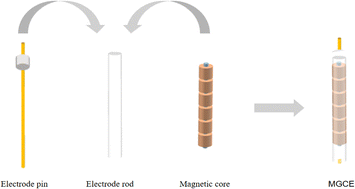
This study presents a novel strategy for fabricating a Fe3O4@SiO2/MoS2-based magnetoelectrochemical sensor through the direct integration of magnetic nanomaterials with a magnetic glassy carbon electrode (MGCE). A key innovation lies in the substitution of the conventional glassy carbon electrode (GCE) with an MGCE, which eliminates the need for polymeric binders. This binder-free approach significantly enhances the interfacial interaction between the electrode and the magnetic nanocomposite, ensuring firm and direct contact between the catalytic material and the electrode surface. As a result, both the catalytic activity and electron transfer efficiency are markedly improved. The Fe3O4@SiO2/MoS2/MGCE sensor, fabricated via a drop-coating method, exhibits outstanding performance in the electrocatalytic detection of nitrite. In comparison to the Fe3O4@SiO2/MoS2/GCE, the proposed MGCE-based sensor offers a substantially enlarged electroactive surface area, facilitating the capture of a greater number of target analyte molecules. This architectural advantage leads to enhanced sensitivity and an exceptionally low detection limit of 0.08 µM. Comprehensive electrochemical evaluation demonstrated that the sensor possesses a broad linear dynamic range from 0.25 to 4948 µM, accompanied by an excellent correlation coefficient (R2 = 0.999). The achieved sensitivity of 1.05 µA µM−1 cm−2 notably surpasses that of a conventional binder-modified GCE. These results underscore the Fe3O4@SiO2/MoS2 nanocomposite as a highly promising platform for electrochemical nitrite sensing, with significant potential for application in environmental monitoring.
 Please wait while we load your content...


