


 PLATFORM UPDATE:


Direct electrodeposition of NiFe-based high-entropy compounds on nickel foam advanced electrocatalysts for the oxygen evolution reaction
 *a
Jitao
Yang,
a
*a
Jitao
Yang,
a
Abstract
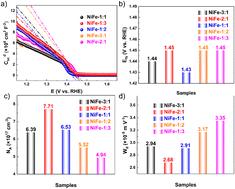
Electrochemical water splitting for hydrogen production is highly dependent on the efficiency of the oxygen evolution reaction (OER). While NiFe-based electrocatalysts are widely studied, their performance is often constrained by limited active sites and structural stability. This study presents a novel NiFe high-entropy compound synthesized via a facile one-step electrodeposition method. By systematically tuning the Ni/Fe atomic ratio, the optimized NiFe-2 : 1 electrode exhibits exceptional OER performance, achieving an ultralow overpotential of 232 mV at 10 mA cm−2 and a Tafel slope of 56.70 mV dec−1 in 1.0 M KOH. Structural and spectroscopic analyses (XRD, XPS, and TEM) confirm the formation of an amorphous structure with mixed valence states (Ni0/Ni2+ and Fe0/Fe2+), which facilitates electron transfer and optimizes adsorption energetics. Mott–Schottky analysis further reveals that NiFe-2 : 1 exhibits a high acceptor concentration (7.71 × 1017 cm−3) and p-type semiconductor behavior, contributing to enhanced charge transport and catalytic kinetics. The electrode also demonstrates outstanding long-term stability, maintaining its activity over 100 h without structural degradation. This work highlights the significance of electronic structure modulation through compositional engineering in high-entropy electrocatalysts, offering a scalable and efficient strategy for advancing alkaline water electrolysis.
 Please wait while we load your content...


