


 PLATFORM UPDATE:


Electrostatic adsorption-assisted self-assembly of SO4-ZIF-67/BiOBr Z-type heterojunctions via ammonium sulfate etching and their efficient degradation of tetracycline
 *a
*a
Abstract
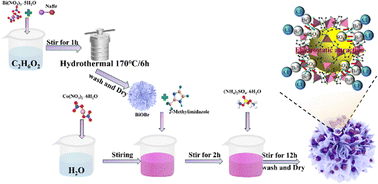
Based on electrostatic adsorption theory, this study innovatively employs an aqueous-phase synthesis method combining in situ growth and simultaneous etching to successfully prepare SO4-ZIF-67/BiOBr Z-type heterojunction composite photocatalysts. Experimental results demonstrate that 30% SO4-ZIF-67/BiOBr achieves an 89.72% degradation rate of TC under visible light, representing 3.95, 16, and 1.59 times improvements over pure BiOBr, SO4-ZIF-67, and ZIF-67/BiOBr, respectively. A series of characterization analyses revealed that the performance enhancement stems from the following factors: first, this material utilizes the surface anchoring of SO42− on ZIF-67 and the electrostatic adsorption between SO42− and BiOBr to construct a uniform and dense interfacial structure. The vacant orbitals of sulfur atoms in SO42−, with their high electronegativity, rapidly capture photoelectrons. Increasing the hole density near the Fermi level of the material promotes electron migration toward the material and forms a stable trap state. The uniform interfacial charge effect synergizes with the Z-type heterojunction to achieve enhanced charge separation and migration. Second, SO42− modification and the uniform morphology induced by electrostatic adsorption contribute to spectral broadening and increased specific surface area, further enhancing surface activity and adsorption capacity. This study provides a novel strategy for constructing highly efficient Z-type photocatalytic systems through surface modification of nanomaterials and electrostatic adsorption.
 Please wait while we load your content...


