


 PLATFORM UPDATE:


An integrated photo-rechargeable ZnMoO4//reduced graphene oxide hydrogel supercapacitor

Abstract
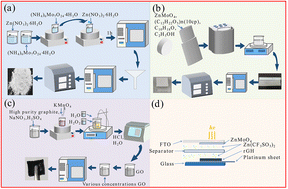
In this study, a photorechargeable supercapacitor was prepared with ZnMoO4, Zn(CF3SO3)2 and reduced graphene oxide hydrogel (rGH) as the photoanode, electrolyte and cathode, respectively. The microstructure, phase composition, light absorbance, specific surface area and chemical structure of products and the photoelectrochemical performance of supercapacitors were characterized using field emission scanning electron microscopy (FESEM), X-ray diffraction (XRD), high-resolution transmission electron microscopy (HR-TEM), ultraviolet-visible (UV-vis) spectroscopy, Fourier transform infrared (FTIR) spectroscopy, X-ray photoelectron spectroscopy (XPS), Raman spectroscopy, and electrochemical workstation. The ZnMoO4//rGH supercapacitor exhibited a high specific capacity of 156.09 F g−1 under photoelectric synergistic charging (namely, a light intensity of 95 mW cm−2 and a current density of 0.5 A g−1), which increased by 35.66% relative to that of only electric charging. Meanwhile, the capacity retention and coulombic efficiency rates of the device are 137% and 100%, respectively, under photoelectric synergistic charging and discharging for 10 000 cycles. This suggests that the ZnMoO4//rGH photorechargeable supercapacitor exhibits excellent stability and shows applications in the wearable electronic industry.
 Please wait while we load your content...


