


 PLATFORM UPDATE:

A comprehensive toolkit for micro- to nanoplastic analysis
 *a
and
*a
and
Abstract
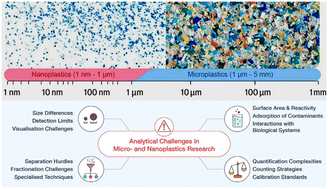
Micro- and nanoplastic (MNP) particles have emerged as a novel class of anthropogenic contaminants, now recognized as pervasive across all environmental compartments and in food and drinking water. Their extreme heterogeneity in size, morphology, density, polymer type, surface chemistry, and degree of aging presents major analytical challenges, with reported abundances spanning up to ten orders of magnitude. Reliable assessment of their occurrence and impacts therefore requires advanced analytical approaches capable of identifying, quantifying, fractionating, and characterizing these particles across scales. This review systematically evaluates state-of-the-art analytical strategies for MNP detection, organized into four major categories: mass-based identification methods (e.g., Py-GC/MS, TED-GC/MS, MALDI-ToF/MS), particle-based quantification techniques (e.g., μ-FTIR, μ-Raman, ToF-SIMS), separation and fractionation methods (e.g., FFF and HDC-SEC coupled with spectroscopy or mass spectrometry), and morphological and surface characterization tools (e.g., SEM/EDX, AFM-IR, nano-FTIR, SP-ICP-MS). For each category, we critically assess detection limits, strengths, and limitations, highlighting their suitability for micro- versus nanoplastic detection. Special attention is devoted to emerging approaches that push detection toward the nanoscale, as well as the need for harmonization and standardization across methodologies. By comparing and integrating these techniques, we outline how complementary approaches can provide comprehensive characterization of MNPs and support reliable risk assessment. Finally, future perspectives are discussed for advancing analytical sensitivity, method automation, and cross-disciplinary standardization to address the global challenge of MNP pollution.
- This article is part of the themed collections: Environmental Science: Nano Recent Review Articles and Recent Open Access Articles - Environmental Science: Nano
 Please wait while we load your content...


