


 PLATFORM UPDATE:


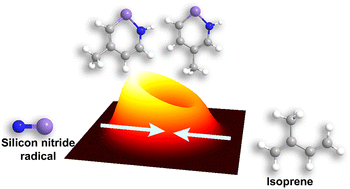
Exploring the cyclization reaction channel for the gas-phase elementary reaction between the silicon nitride radical (SiN, X2Σ+) and isoprene (C5H8, X1A′) to prepare methylazasilacyclohexadienylidenes (SiNC5H7, X1A′)
 a
Iakov A.
Medvedkov,
a
Daniel
González,
a
Shane J.
Goettl,
a
André K.
Eckhardt
*b
and
Ralf I.
Kaiser
*a
a
Iakov A.
Medvedkov,
a
Daniel
González,
a
Shane J.
Goettl,
a
André K.
Eckhardt
*b
and
Ralf I.
Kaiser
*a
Abstract
Silicon-containing heterocyclic molecules have emerged as promising candidates in medicinal and agrochemical research. However, the synthesis of silicon-containing heterocycles has remained highly challenging. In this work, we employed the crossed molecular beams technique to elucidate the underlying reaction pathways for the synthesis of a unique class of six-membered cyclic organosilicon molecules in which silicon and nitrogen atoms occupy adjacent positions: methyl-azasilacyclohexadienylidenes – silicon and nitrogen substituted benzenes functionalized with a methyl group. This class was accessed via the reaction of ground-state silicon nitride radicals (SiN, X2Σ+) with isoprene (C5H8, X1A′) under single-collision conditions at a collision energy of 25 ± 1 kJ mol−1. Integration of experimental results with electronic structure calculations revealed the formation of at least two cyclic products: 4-methyl-1-aza-2-silacyclohexa-3,5-dien-2-ylidene and 5-methyl-1-aza-2-silacyclohexa-3,5-dien-2-ylidene. The underlying mechanism shows strong similarities to the previously studied reaction of the silicon nitride radicals (SiN, X2Σ+) with 1,3-butadiene (C4H6, X1Ag), with the methyl group in isoprene classified as a spectator, thus advancing our fundamental understanding of the organosilicon chemistry through the delivery of synthetic pathways to a distinct class of silicon-containing heterocyclic molecules: methylazasilacyclo-hexadienylidenes.
 Please wait while we load your content...


