


 PLATFORM UPDATE:


Dimer formation of 7-azaindole in phosphonium-based ionic liquids: anion-dependent behavior

Abstract
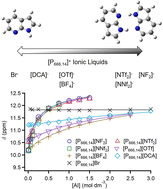
In this study, we have investigated the dimer formation behavior of 7-azaindole (AI) in trihexyltetradecylphosphonium ([P666,14]+) based ionic liquids (ILs) with seven anion species (bis(fluorosulfonyl)amide [NF2]−, bis(trifluoromethylsulfonyl)amide [NTf2]−, bis(nonafluorobutylsulfonyl)amide [NNf2]−, trifluoromethanesulfonate [OTf]−, tetrafluoroborate [BF4]−, dicyanamide [DCA]−, and bromide Br−) using 1H NMR. The physicochemical properties of the liquids, such as density, viscosity, surface tension, and electrical conductivity, as well as solvent polarity parameters (donor number DN, acceptor number AN, and π* polarity), were also characterized for all seven ILs in this study. The dimerization constant K, estimated from the concentration-dependent chemical shift of the proton attached to the nitrogen atom at the 7-position of AI, increases with decreasing DN of the ILs, while that is not correlated with AN and π* polarity. The relation between K and DN in the ILs qualitatively agrees with the behavior observed in common organic solvents. However, AI dimerization in the present ILs occurs even in ILs with higher DN than those of common organic solvents. This behavior is likely attributed to the extensive nonpolar regions formed by the nanosegregated structure of the ILs. The thermal stability and phase-transition properties of the present ILs were also characterized.
 Please wait while we load your content...


