


 PLATFORM UPDATE:


A comparative theoretical study on the vibrational spectra of V2O5·nH2O
 *a
*a
Abstract
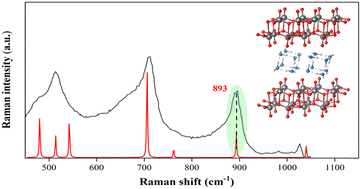
The structural and vibrational properties of hydrated vanadium pentoxide (V2O5·nH2O) were investigated using first-principles density functional theory (DFT) calculations. Comparative analysis revealed characteristic Raman peaks arising from interlayer water molecules and elucidated the evolution of the Raman spectra as a function of the hydration level. Notably, V2O5·H2O does not adopt a strictly monoclinic lattice with C2/m symmetry. Instead, it exhibits an in-plane disordered structure that can be approximated by a triclinic unit cell closely resembling C2/m symmetry. In contrast to anhydrous α-V2O5, hydrated V2O5·nH2O phases display distinct vibrational spectral signatures, including a Raman-active peak at approximately 760 cm−1, corresponding to V–O3–V stretching modes, and a pronounced enhancement near 890 cm−1, associated with water-related modes. In partially hydrated systems (V2O5·0.5H2O and V2O5·1.5H2O), the framework disorder induces peak splitting. Molecular dynamics simulations, employing a machine learning-based force field applied to a supercell comprising 2560 atoms, demonstrate that the vibrational density of states (VDOS) for water molecules shifts from approximately 400 cm−1 to 900 cm−1 with increasing hydration. This study provides a comprehensive analysis of the vibrational modes in bilayer V2O5·nH2O, offering critical insights into the vibrational spectra relevant to experimental studies of V2O5-based electrode materials.
 Please wait while we load your content...


