


 PLATFORM UPDATE:


Initiating olefin metathesis: alkylidenes from molecular Mo(iv)-oxo species, olefins and base-promoted proton transfer

Abstract
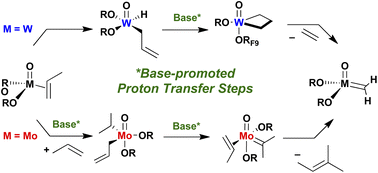
In olefin metathesis, metal alkylidenes and metallacyclobutanes are the two key intermediates of the Chauvin mechanism. In industrial metathesis catalysts based on supported group 6 metal oxides (e.g. MOx/SiO2), these intermediates, proposed to be in the +VI oxidation state, are postulated to be formed in situ from olefins and transient low-valent species in the +IV oxidation state. While recent studies have shown that molecularly-defined W(IV)-oxo species initiate olefin metathesis through C–H bond activation and proton transfer steps to generate metallacyclobutanes, less is known about the corresponding Mo-based systems. Here, we report the synthesis of a pyridine-stabilized Mo(IV)-oxo compound, [MoO(OC(CF3)3)2py3], and show that this compound also initiates olefin metathesis, once activated with B(C6F5)3. This activation is evaluated to have a low efficiency (≈0.2%) and illustrates the difficulty in generating active species from low valent sites, thus explaining the relatively low activity of classical heterogeneous catalysts. DFT calculations support that the initiation steps differ from W: Mo enters the catalytic cycles from the metal alkylidenes rather than metallacyclobutanes for W, while still involving C–H activation and base-assisted proton transfers as common elementary steps. Initiation through proton transfer better explains the role of promoters in the corresponding heterogeneous catalysts.
 Please wait while we load your content...


