


 PLATFORM UPDATE:


Protein chirality as a determinant of ligand affinity: insights from l- and d-streptavidin
 a
Peter C. S.
Woodham,
a
Steven R. E.
Draper,
†a
Paul
Spaltenstein,
‡a
Frank G.
Whitby,
a
Michael S.
Kay
*a
a
Peter C. S.
Woodham,
a
Steven R. E.
Draper,
†a
Paul
Spaltenstein,
‡a
Frank G.
Whitby,
a
Michael S.
Kay
*a
Abstract
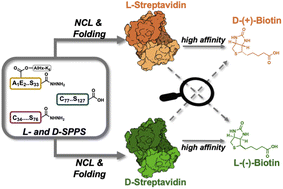
Streptavidin enjoys numerous biotechnological applications due to its extraordinarily high affinity for biotin and the ease of biotinylation of targets through chemical or biological means. However, two main drawbacks limit its use in therapeutic and diagnostic applications: high immunogenicity and endogenous biotin interference. We propose that a mirror-image biotin/streptavidin system could solve these problems due to the minimal immunogenicity of mirror-image (D-) proteins and the expected lower binding affinity between non-natural D-streptavidin and natural D-biotin. To comprehensively address this problem, we first synthesized the L- and D-enantiomers of streptavidin using a three-segment native chemical ligation approach. This synthesis was enabled by temporarily solubilizing an aggregation-prone peptide segment with a Glu-based AlHx ‘helping hand’ linker. We developed a novel high-efficiency folding protocol and characterized the synthetic proteins by circular dichroism, size-exclusion chromatography, and binding to natural D-(+)-biotin and the mirror-image L-(−)-biotin via isothermal titration calorimetry. We found a 200-million-fold difference in affinity between streptavidin and its matched vs. mismatched biotin enantiomers that renders these systems functionally orthogonal. To gain further insight into how (−)-biotin binds recombinant streptavidin, we solved high-resolution X-ray crystal structures for both the matched and mismatched interactions. This work demonstrates the high degree of stereospecificity of the streptavidin/biotin interaction and the potential utility of a mirror-image biotin/streptavidin system for therapeutic and diagnostic applications.
 Please wait while we load your content...


