Issue 58, 2025

Integrating experimental data and machine learning models for solubility prediction of yellow 23 in supercritical carbon dioxide

Abstract

This study reports, for the first time, the solubility investigation of yellow 23 in supercritical carbon dioxide over a pressure range of 12–30 MPa and a temperature range of 313–343 K. Yellow 23's experimental molar solubilities in supercritical carbon dioxide were found to be between 6.67 × 10⁻⁵ to 20.55 × 10⁻⁵ (313 K), 4.32 × 10⁻⁵ to 23.58 × 10⁻⁵ (323 K), 3.41 × 10⁻⁵ to 27.37 × 10⁻⁵ (333 K) and 2.29.3 × 10−5 to 3.840.4 × 10−5 (343 K). Four semiempirical correlations (MST, Chrastil, Bartle et al., and K-J) were used to calculate the solubility of yellow 23 in supercritical carbon dioxide. The machine learning models (Multilayer Perceptron, Gaussian process regression, Random Forest) models were considered for modeling in this research. The K-J model proved to be the most suitable for fitting the experimental data, exhibiting the lowest mean absolute relative deviation of 6.39%. All three machine learning models have impressive act on approximation of yellow 23 solubility. However, model MLP with the highest R2 (99.7) and lowest MSE (0.001) was selected as the best among the three models.
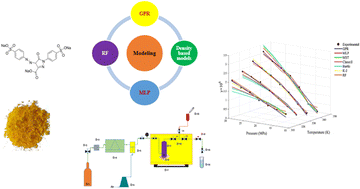
Graphical abstract: Integrating experimental data and machine learning models for solubility prediction of yellow 23 in supercritical carbon dioxide

Article information

Article type
Paper
Submitted
03 Nov 2025
Accepted
09 Dec 2025
First published
16 Dec 2025
This article is Open Access
Creative Commons BY-NC license

RSC Adv., 2025,15, 50494-50506

Integrating experimental data and machine learning models for solubility prediction of yellow 23 in supercritical carbon dioxide

S. A. Sajadian, A. H. Sheikhshoaei, N. Esfandiari and A. Noubigh, RSC Adv., 2025, 15, 50494 DOI: 10.1039/D5RA08456C

This article is licensed under a Creative Commons Attribution-NonCommercial 3.0 Unported Licence. You can use material from this article in other publications, without requesting further permission from the RSC, provided that the correct acknowledgement is given and it is not used for commercial purposes.

To request permission to reproduce material from this article in a commercial publication, please go to the Copyright Clearance Center request page.

If you are an author contributing to an RSC publication, you do not need to request permission provided correct acknowledgement is given.

If you are the author of this article, you do not need to request permission to reproduce figures and diagrams provided correct acknowledgement is given. If you want to reproduce the whole article in a third-party commercial publication (excluding your thesis/dissertation for which permission is not required) please go to the Copyright Clearance Center request page.

Read more about how to correctly acknowledge RSC content.

Social activity

Spotlight

Advertisements