


 PLATFORM UPDATE:

Machine learning-based prediction and mechanistic insight into PFAS adsorption on carbon-based materials
 a
a
Abstract
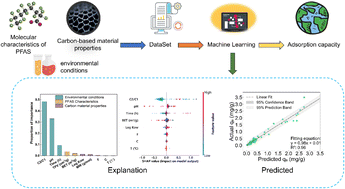
Carbon-based materials hold significant potential in environmental remediation, as they can effectively remove per- and polyfluoroalkyl substances (PFAS) through adsorption, thereby influencing their environmental behavior and associated risks. However, due to the complexity of the physicochemical properties of carbon-based materials, the molecular diversity of PFAS—including variations in chain length, functional groups, and degree of fluorination—as well as differences in environmental conditions, it remains challenging to fully elucidate the adsorption mechanisms solely through experimental approaches. In this study, a gradient boosting decision tree (GBDT) model was developed and optimized to systematically predict the adsorption performance of carbon-based materials toward PFAS. The GBDT model demonstrated excellent predictive accuracy on the test dataset, achieving an R2 of 0.96 and a root mean square error (RMSE) of 0.02. Model interpretation using Shapley additive explanations (SHAP) and partial dependence plots revealed that environmental conditions contributed the most to adsorption, followed by the physicochemical characteristics of carbon-based materials and the molecular features of PFAS. Specifically, solution pH, the number of fluorine atoms within PFAS molecules, temperature, and the pore structure of carbon-based materials were identified as the most influential factors, with electrostatic interactions and hydrophobic–hydrophilic character are likely the dominant mechanisms. This study provides a novel perspective that integrates machine learning with environmental chemistry to enhance understanding of PFAS–carbon interactions, offering valuable insights for environmental risk assessment and the rational design of functional materials.
 Please wait while we load your content...


