


 PLATFORM UPDATE:

Synthesis of a 3D-interconnected hierarchical porous carbon–copper oxide nanocomposite derived from cantaloupe fruit peel for high-performance symmetric supercapacitors
 a
H.
Devendrappa
*a
a
H.
Devendrappa
*a
Abstract
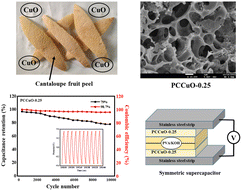
The growing demand for efficient and sustainable energy storage devices has driven researchers to develop advance materials to fulfill the global needs. In this work, a three-dimensional (3D)-interconnected hierarchical porous carbon/copper oxide (PCCuO) nanocomposite derived from cantaloupe fruit peel was synthesized by a one-step activated carbonization method. The SEM images show a well-defined macroporous morphology with a uniform distribution of copper oxide nanoparticles and clear evidence of chemical interaction and structural modification. Owing to a 3D-interconnected porous structure and a specific surface area of up to 307.29 m2 g−1, the PCCuO-0.25 electrode demonstrates exceptional electrochemical performance, achieving a specific capacitance of 673 F g−1 at a current density of 1.5 A g−1 in a 6 M KOH electrolyte. A symmetric supercapacitor utilizing PCCuO-0.25 as both positive and negative electrodes, along with a PVA/KOH gel electrolyte, attains a maximum energy density of 51.4 Wh kg−1 at a power density of 616.8 W kg−1, showing outstanding cycle stability with a capacitance retention of 79% and a coulombic efficiency of 98.7% after 10 000 charging–discharging cycles. This study offers a comprehensive investigation into the fabrication of supercapacitors using biomass-derived materials, aiming to provide an effective approach for producing environmentally friendly, cost-efficient, and high-performance supercapacitor electrode materials.
 Please wait while we load your content...


