


 PLATFORM UPDATE:


Synthesis of a C-TiO2/BiOCl Z-scheme composite photocatalyst for the photocatalytic degradation of tetracycline hydrochloride
 *a
Jyh-Cherng
Chen
c
and
*a
Jyh-Cherng
Chen
c
and
Abstract
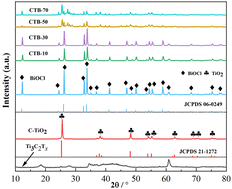
A composite photocatalyst with enhanced catalytic performance (C-TiO2/BiOCl) was prepared through a straightforward precipitation–calcination approach. The structural features, photoelectric behavior, morphology, and photocatalytic efficiency of the synthesized materials were studied via multiple analytical techniques. Compared with C-TiO2 and BiOCl, the C-TiO2/BiOCl composite displayed markedly improved photocatalytic degradation efficiency toward tetracycline hydrochloride (TCH) under simulated solar radiation. The degradation rate of TCH using the 50% C-TiO2/BiOCl (CTB-50) composite photocatalyst reached 89.9%. The increased photocatalytic efficiency of C-TiO2/BiOCl was primarily associated with its enhanced efficiency in separating photogenerated electron–hole pairs. A Z-type heterojunction photocatalytic mechanism with a C-layer as a medium was proposed based on UV-vis diffuse reflectance spectroscopy, photoelectrochemical analysis, and PL spectroscopy.
 Please wait while we load your content...


