


Grafting ethanedithiol moiety on the surface of cellulosic fibers by thioesterification: a simple chemical method

Abstract
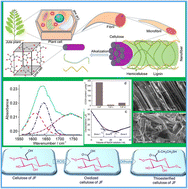
Jute fibers (JFs), in which two-thirds of their total mass is cellulose, are valuable bio-fibers employed from the household to technical applications in the environmental, pharmaceutical, and energy storage fields. However, their poor interfacial adhesion with polymer matrices hinders their widespread industrial application, particularly in composite materials. In this study, JFs were modified by grafting thiol moieties through mild oxidation, followed by esterification in an aqueous solution to enhance their functional performance and broaden their industrial utility. First of all, JFs were collected from a local market and pretreated with an alkali solution and oxidized with 20% Fenton reagent (FR). The desired grafting of thiol moieties was achieved by refluxing the initially oxidized JFs with ethane-1,2-dithiol in acetonitrile using trifluoroacetic acid as a catalyst at 60 °C for 4 h. These materials were characterized by Fourier-transform infrared spectroscopy, conductometric titration, thermogravimetric analysis, X-ray diffraction, scanning electron microscopy, fiber strength and contact angle analyses. The characteristic features of the –COOH groups and conductometric titration confirmed that the amount of –COOH groups decreased after thioesterification, as expected. The degree of oxidation of cellulose on the fiber surface was about 4.5%. The changes in crystallinity, surface morphology, tensile strength, and thermal stability support the efficient grafting of thiol moieties on the surface of JFs. The absorption bands corresponding to the –C![[double bond, length as m-dash]](https://www.rsc.org/images/entities/char_e001.gif) O and –C(O)–S– groups in the FT-IR spectra suggested the desired modification. 20% FR was sufficient for introducing a significant amount of these groups (280.39 μmol g−1). The increased hydrophobicity of the thiol-grafted JFs, as evaluated by contact angle measurements, evidenced the expected modification. With this enhanced surface functionality, the modified JFs show potential for applications in heavy metal remediation, industrial dye removal, wastewater treatment, and composite reinforcement, offering a sustainable and eco-friendly solution to environmental and industrial challenges.
O and –C(O)–S– groups in the FT-IR spectra suggested the desired modification. 20% FR was sufficient for introducing a significant amount of these groups (280.39 μmol g−1). The increased hydrophobicity of the thiol-grafted JFs, as evaluated by contact angle measurements, evidenced the expected modification. With this enhanced surface functionality, the modified JFs show potential for applications in heavy metal remediation, industrial dye removal, wastewater treatment, and composite reinforcement, offering a sustainable and eco-friendly solution to environmental and industrial challenges.
 Please wait while we load your content...


