


 PLATFORM UPDATE:


Electroporation in lipid vesicles by varying PEG-grafted lipids in their membranes: an experimental and simulation study

Abstract
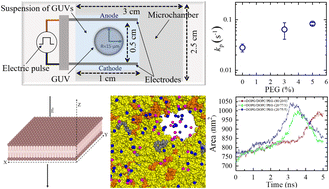
Polyethylene glycol (PEG)-grafted phospholipids alter the mechanical stability of membranes, which may greatly influence the electroporation behavior of PEG-grafted membranes. However, the underlying mechanism of electroporation in a lipid bilayer containing varying mole% of PEG-lipids remains unclear. In this study, we present both experimental observations and molecular dynamics (MD) simulations to investigate the electroporation process and its associated biophysical properties. Initially, the rupture behavior of giant unilamellar vesicles (GUVs) incorporating different mol% of PEG-grafted phospholipids was examined under a constant membrane tension of 5 mN m−1. Results showed that with the increasing PEG-lipid%, the probability and rate constant of rupture increased, while the average survival time of the vesicles decreased, indicating reduced membrane stability. Subsequently, MD simulations were performed to model electroporation in a bilayer with varying PEG-lipid% under a constant DC electric field of 0.4 V nm−1. The time required for electroporation decreased as the PEG-lipid concentration increased. Several physical properties, such as potential energy, solvent accessible surface area (SASA), number of hydrogen bonds (H-bonds), dipole moment, and epsilon and Kirkwood factor, were evaluated. Electroporation was marked by a sharp drop in the potential energy and simultaneous increase in SASA, H-bonds, dipole moment, and dielectric constant, collectively capturing the destabilization and pore formation process at the molecular level. The simulation results were in full agreement with the experimental findings. Alterations in membrane fluidity, electrostatic characteristics, and mechanical stability caused by PEG-lipids in the bilayer are the main reasons for the change in the electroporation dynamics. These insights advance our understanding of membrane behavior and contribute to the development of an efficient electroporation technique with significant biotechnological and medical applications.
 Please wait while we load your content...


