


 PLATFORM UPDATE:


Spectrophotometric determination of sulfanilamide using PMDA as a π-acceptor: method optimization, validation, and computational study

Abstract
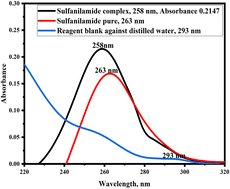
A new, quick, economical, accurate and precise spectrophotometric method was developed for the determination of sulfanilamide in its pure form. This technique focused on the reaction of this amine as an n-donor via the charge-transfer complex formation reaction with pyromellitic dianhydride (PMDA) as a π-acceptor. The maximum absorption of sulfanilamide was at 258 nm. Beer's law was observed over the concentration range of 0.2–35 μg mL−1 with a molar absorptivity value of 16 226.24 L mol−1 cm−1. The accuracy of the method (average recovery %) was 101.501%, and its precision (RSD %) was less than 0.6%. The nature of PMDA complexes with sulfanilamide was studied using the mole ratio method. The findings demonstrated that this complex was produced in a ratio of 1 : 1 with a stability constant of 2.49 × 10⁸ L mol−1 for the amine-PMDA complex. The detection limit (LOD) was 0.0136 μg mL−1, and the limit of quantification (LOQ) was 0.0412 μg mL−1. DFT calculations were employed to learn more about the charge transfer mechanism. Density of states (DOS) calculations demonstrated electronic interactions near the Fermi level, in which nitrogen and sulfur orbitals from sulfanilamide act as electron donors, while the carbonyl group and aromatic system of PMDA act as electron acceptors. HOMO–LUMO analysis further confirmed this donor–acceptor mechanism.
 Please wait while we load your content...


