


 PLATFORM UPDATE:


Benzilmonoximethiocarbohydrazide Schiff bases as multifunctional antimalarial and antioxidant scaffolds: synthesis, biological evaluation, and mechanistic insights
 †a
Abhay
Bagul,
†b
Manish
Kumar,
c
Aisha
Tufail,
d
Santosh Waman
Kulkarni,
e
Sheetal
Sharma
a
and
Amit
Dubey
*f
†a
Abhay
Bagul,
†b
Manish
Kumar,
c
Aisha
Tufail,
d
Santosh Waman
Kulkarni,
e
Sheetal
Sharma
a
and
Amit
Dubey
*f
Abstract
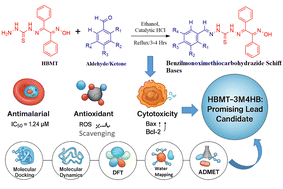
A new series of benzilmonoximethiocarbohydrazide (HBMT) Schiff bases was synthesized and structurally characterized with high purity. Four derivatives—HBMT-3M4HB, HBMT-MA3, HBMT-MA6, and HBMT-MA7—were obtained in good yields and evaluated for multifunctional therapeutic potential. All compounds showed significant antimalarial activity against Plasmodium falciparum 3D7, with HBMT-3M4HB being the most potent (IC50 = 1.24 μM), approaching chloroquine. Antioxidant assays revealed that HBMT-3M4HB also exhibited strong radical scavenging and ferric reducing power, surpassing its analogues. Cytotoxicity testing in MCF-7 breast cancer cells indicated selective activity (IC50 = 21.6 μM) with reduced toxicity toward HEK-293 cells. Mechanistic assays suggested apoptosis induction, suppression of pro-inflammatory mediators, and enhancement of antioxidant defense pathways. Complementary computational studies supported the experimental findings, showing favorable electronic properties, stable binding to malarial protein targets, and drug-like pharmacokinetic predictions. Collectively, these results establish HBMT Schiff bases, particularly HBMT-3M4HB, as promising multifunctional scaffolds with combined antimalarial, antioxidant, and selective cytotoxic activities, offering potential for further preclinical development.
 Please wait while we load your content...


