Issue 51, 2025, Issue in Progress

Optimising the materials for triboelectric nanogenerator to harvest the wrist pulse signal: a numerical study using the finite element method

Abstract

This study outlines the optimised materials used to improve the output performance of a triboelectric nanogenerator based on the contact separation mode. The selection of materials plays a crucial role in enhancing the output voltage of the triboelectric nanogenerator. This study involves the design of three distinct triboelectric nanogenerator models using polytetrafluoroethylene (PTFE), polydimethylsiloxane (PDMS), and silicone. Numerical analysis is conducted using the finite element method in COMSOL Multiphysics software to determine the output performance of these models under externally applied pulse pressure. The output voltage profiles of each model are compared, and it is observed that the PTFE-based model consistently produces an output voltage of 26 V when subjected to a pulse pressure of 3 kPa. These devices are well-suited for use in healthcare monitors, human motion detection, and gesture monitoring because of their inherent self-powering capability.
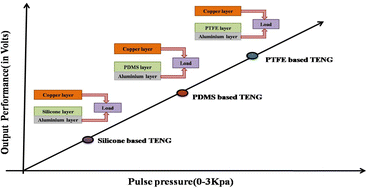
Graphical abstract: Optimising the materials for triboelectric nanogenerator to harvest the wrist pulse signal: a numerical study using the finite element method

Article information

Article type
Paper
Submitted
17 Aug 2025
Accepted
15 Oct 2025
First published
07 Nov 2025
This article is Open Access
Creative Commons BY-NC license

RSC Adv., 2025,15, 43357-43365

Optimising the materials for triboelectric nanogenerator to harvest the wrist pulse signal: a numerical study using the finite element method

V. Karthikeyan and S. Vivekanandan, RSC Adv., 2025, 15, 43357 DOI: 10.1039/D5RA06066D

This article is licensed under a Creative Commons Attribution-NonCommercial 3.0 Unported Licence. You can use material from this article in other publications, without requesting further permission from the RSC, provided that the correct acknowledgement is given and it is not used for commercial purposes.

To request permission to reproduce material from this article in a commercial publication, please go to the Copyright Clearance Center request page.

If you are an author contributing to an RSC publication, you do not need to request permission provided correct acknowledgement is given.

If you are the author of this article, you do not need to request permission to reproduce figures and diagrams provided correct acknowledgement is given. If you want to reproduce the whole article in a third-party commercial publication (excluding your thesis/dissertation for which permission is not required) please go to the Copyright Clearance Center request page.

Read more about how to correctly acknowledge RSC content.

Social activity

Spotlight

Advertisements