


 PLATFORM UPDATE:


Smart biocomposite hydrogels in action: unraveling the roles of lignin, temperature, and crosslinker on drug release

Abstract
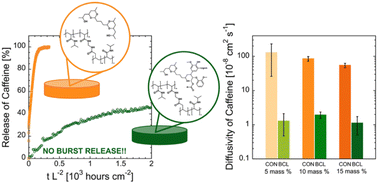
In this study, the release kinetics of a model water-soluble drug, caffeine, from thermoresponsive biocomposites, comprised of lignin, poly(N-isopropylacrylamide) (PNIPAm), and poly(vinyl alcohol) (PVA) were studied. Specifically, two series of soft biocomposites were fabricated—one containing softwood Kraft lignin at a 2 : 2 : 1 (lignin : PNIPAm : PVA) mass ratio and one at a 2 : 3 (PNIPAm : PVA) mass ratio, with the latter serving as a control membrane to those containing lignin. The crosslink density of these soft biocomposites was altered by systematically varying the concentrations of both glutaraldehyde, the crosslinker for lignin and PVA, and methylenebisacrylamide, the crosslinker for PNIPAm, between 5 and 15 mass%, respective to the dry polymer masses. At room temperature, the introduction of lignin in the membranes led to a reduction in diffusivity. Notably, the diffusivity of caffeine from membranes with 5 mass% crosslinker was seen to decrease by approximately two orders of magnitude when compared to the control membranes. However, in lignin-containing composites synthesized with 15 mass% crosslinker, caffeine diffusivity increased by nearly an order of magnitude at temperatures above the volume phase transition temperature of PNIPAm compared to the same membrane at room temperature. The most significant increase occurred in the highest concentration studied. Across the membranes studied, the diffusivity of caffeine did not exhibit any consistent trends with varying crosslinker composition. In addition to caffeine release kinetics, the equilibrium water uptake (EWU) of each membrane was measured. In general, the EWU was seen to decrease with increases in crosslinker concentrations.
 Please wait while we load your content...


